An AI-driven virtual tutor for computer science education
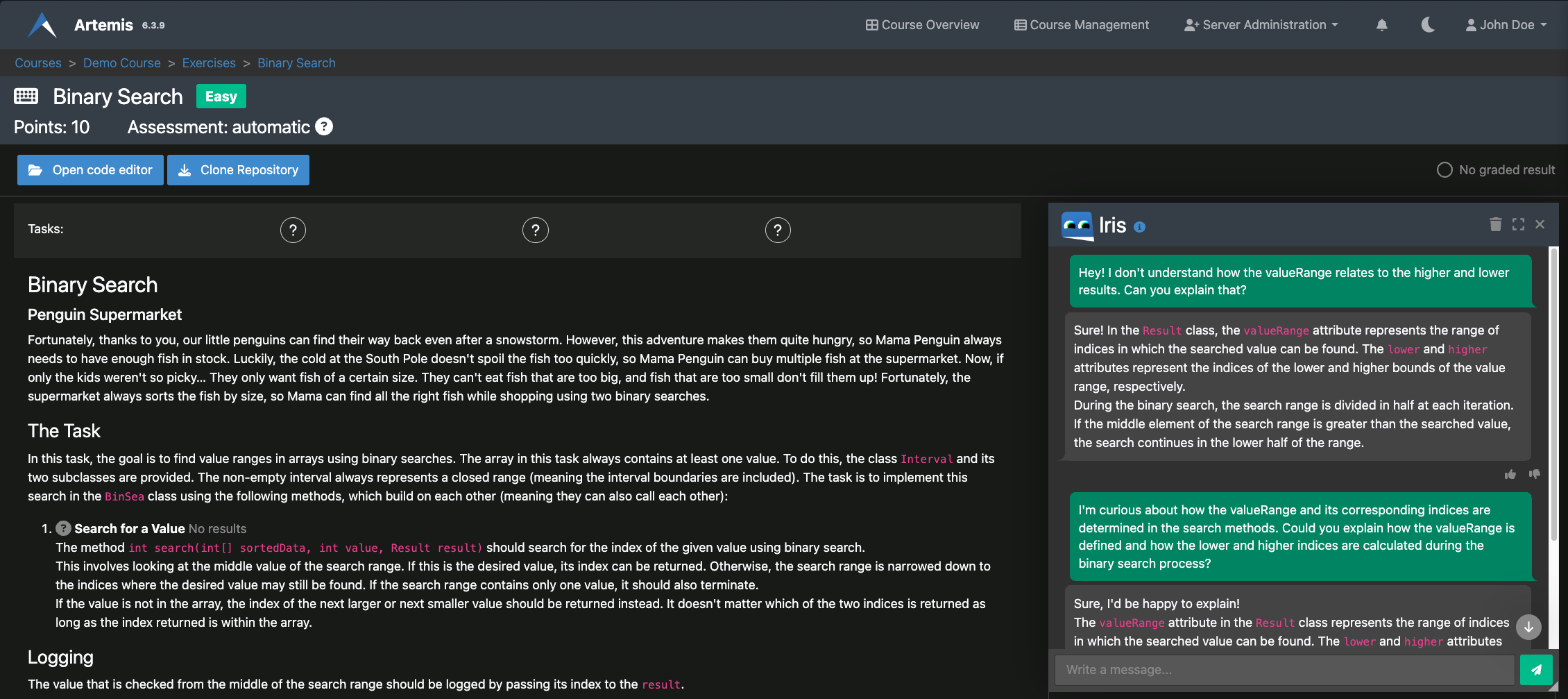
Iris is an advanced AI-driven virtual tutor integrated into the open-source learning platform Artemis, designed to provide personalized and context-aware support to computer science students as they tackle programming exercises. Leveraging large language models (LLMs), Iris acts as a didactically calibrated tutor: instead of revealing complete solutions, it offers subtle hints and counter-questions to foster independent problem-solving and cognitive development. Additionally, Iris can access lecture content, enabling it to tap into course-specific knowledge for more tailored and relevant responses.
How It Works
Iris is accessible to students via a chat interface directly within the Artemis web application. Unlike external chatbots that require students to manually copy-paste code and exercise descriptions, Artemis embeds Iris directly within its framework, granting automated access to problem statements, the student’s current code submissions, build logs, automated test results, and prior attempts.
Iris employs a multi-step interaction strategy to ensure pedagogically sound responses. First, it assesses the relevance of the student’s question, filtering off-topic queries. It then selects the most pertinent files from the student’s exercise repository and generates a response grounded in the exercise context. A post-generation self-check verifies that the response adheres to the tutor role and does not inadvertently reveal solutions. The system modulates help along four ascending tiers: subtle hints that focus attention on salient code lines, guiding questions that provoke reflection, high-level conceptual feedback that offers strategic guidance, and generalized examples that illustrate analogous patterns — all while deliberately keeping the target solution opaque.
Beyond exercise support, Iris grounds its responses in authoritative course content through a retrieval-augmented generation (RAG) pipeline. The system ingests lecture slide decks, video transcripts, FAQs, and documentation into a vector store, and retrieves relevant passages to align its guidance with the terminology and concepts students encountered in class.
Research Findings
Iris is actively deployed at the Technical University of Munich, where it supports thousands of students across multiple introductory programming courses. The project has been rigorously evaluated through empirical studies:
- Student perception (ITiCSE 2024, N=1,655 enrolled students): A significant majority of students perceive Iris as effective at understanding their queries and providing relevant assistance. 92% feel comfortable asking Iris questions without fear of judgment, and students are more open to using Iris during lectures than asking the professor directly.
- Complementary role: Students value Iris as a complement to, rather than a replacement for, human tutors. They feel confident solving exam tasks independently, indicating that Iris fosters learning without creating over-reliance.
- Scaffolded AI vs. unrestricted AI (Computers & Education: AI, N=275 RCT): In a three-arm randomized controlled trial comparing Iris, ChatGPT, and traditional resources, both AI groups achieved higher exercise scores, but neither AI condition produced greater learning gains. Critically, only Iris increased intrinsic motivation, while both AI groups reduced frustration and cognitive load. The findings suggest that scaffolded, hint-first design preserves motivational benefits, whereas unrestricted AI providing complete solutions can create a “comfort trap” where student preferences misalign with pedagogical effectiveness.
- Context-awareness matters (Koli Calling 2025, N=33 mixed-methods): In a randomized study, context awareness emerged as the most valued feature across all conditions, with both Iris and ChatGPT users expressing universal positive sentiment toward it. Iris users showed descriptively higher learning scores, while ChatGPT users expressed notably stronger over-reliance concerns (70% negative sentiment vs. 33% for Iris) and needed to invest far more effort in verifying AI outputs.
The project has been featured in national media, including a report on ZDF’s heute journal, and has been presented at leading international conferences in computing education.
Vision
In upcoming development phases, Iris will be enhanced with proactive features, allowing it to automatically reach out to students when it detects potential struggles. Further planned capabilities include long-term memory for tracking student progress, support for additional exercise types, automated communication, and knowledge extraction from lecture recordings. The long-term goal is to evolve Iris into a comprehensive “Study Buddy” that accompanies students through all aspects of their learning journey — from daily study activities to exam preparation.
Publications
Less Stress, Better Scores, Same Learning: The Paradox of AI Support in Programming Education
Patrick Bassner,
Ben Lenk-Ostendorf,
Ramona Beinstingel,
Tobias Wasner, and
Stephan Krusche.
In: Computers & Education: Artificial Intelligence.
December
2025.
doi: 10.1016/j.caeai.2025.100537
Towards Understanding the Impact of Context-Aware AI Tutors and General-Purpose AI Chatbots on Student Learning
Patrick Bassner,
Anna Lottner, and
Stephan Krusche.
25th Koli Calling International Conference on Computing Education Research
Koli, Finland,
November
2025.
Iris: An AI-Driven Virtual Tutor for Computer Science Education
Patrick Bassner,
Eduard Frankford, and
Stephan Krusche.
29th Annual Conference on Innovation and Technology in Computer Science Education
(ITiCSE
)
.
Milan, Italy,
July
2024.
AI-Tutoring in Software Engineering Education
Eduard Frankford,
Clemens Sauerwein,
Patrick Bassner,
Stephan Krusche, and
Ruth Breu.
46th International Conference on Software Engineering
(ICSE SEET '24
)
.
Lisbon, Portugal,
April
2024.
doi: 10.1145/3639474.3640061